Showing posts with label social web. Show all posts

Monday, June 23, 2008

Top 20 most influential people in the MMO Industry (2007)....

MMOMost

...are listed here. But if you want to read the rationale behind the choices of those selected, that is the list according to Beckett Massive Online Gamer, you'll need to get their July/August 2008 issue. As a bonus, you'll also get a list of up-and-coming names that will possibly loom large in the 2008 list, along with other information about current and future MMO titles.

MMO games have proven to be the most successful virtual worlds to date, not only in terms of revenue generated, but in how they've captured the focus and time of millions of users. These games are so popular, they provide the opportunity for social uses and activities outside their intended function. I argue that any attempts to bring non-game virtual worlds more into the mainstream of the Social Web, let alone a comprehensive virtual medium, need understand and account for these social phenomena within their own solutions matrices.

Thursday, March 27, 2008

Survey results for virtual worlds collaborative use

Results from a virtual world collaborative use survey undertaken by the Virtual Worlds Consortium for Innovation and Learning, Special Interest Group on Virtual Worlds, the Serious Second Life Group in Boulder, and the MetaverseU Network of Stanford University, have been published under the title: Virtual Worlds and Collaborative Work: Survey Results.

Survey sections are titled: Participants Profile and Background; General Issues and Questions about Virtual Worlds and Collaborative Work; Collaborative Work in Second Life: Now and In the Future; Collaborative Works Using Virtual-World Platforms Other.

The participants were mostly virtual world users or advocates, mostly with a Second Life affinity. There seemed to be a lot of unfamiliarity with other vendors. But there's some interesting surprises I found, such as: the preponderance (read enthusiasm) of business responders vs those from academia; management being seen as a hurdle to virtual world adoption; overwhelmingly positive outlook for Second Life for educational use but uncertainty that it will do as well for business collaboration.

It's a fairly brief document overall so certainly work a look. Though not necessarily comprehensive, it was thought-provoking, especially where I tended to disagree with the majority. It certainly made me think twice about my own opinions.

Tuesday, March 25, 2008

I know the avatar I'm talking to isn't real. But is she real?

Presence can be costly. It's a lot of overhead to consider. And one has to figure that the virtual world never sleeps. Logging into Second Life at different times, it takes on a European, Australian, or Asian tone. Companies have to figure that a visitor might pop in at any time.

Which is why AI avatar "bots" are being developed that can take on that overhead instead of having a real person. They work quite cheap - free in fact beyond their build cost and they don't take breaks. The initial ones are likely going to be fairly simple responders but there are rumblings of some very savvy ones (see Artificial Intelligence Applications in 3d Virtual Worlds) that can do a credible job of mimicking the responses of a real person.

This of course undercuts one of the basic presumptions of virtual worlds, that an avatar represents a real person. One of the interesting aspects of virtual worlds and MMOs is that people tend to treat an avatar at face value, as if they were what they appeared to be. If that avatar appears to be a human man or woman, you, as a virtual world user, would probably respond accordingly. Imagine a virtual world where someone can seed avatars to make a space seem more popular as if other people really found it engaging, making you think twice about stopping to take a look around at the offers. This is already being done in MTV Virtual Worlds: when an event doesn't draw in enough people, bots are seeded to dispell the impression of unpopularity. Or that person chatting you up and that seems so interested in your latest real world shopping adventure could be a bot mining you for buying trends. Or your new "friend,", taking advantage of how viral marketing works, just swears by Eau'dee'doh perfume or MuskOxen deodorant.

"Cogito ergo sum" doesn't quite sum it up any more, does it?

Thursday, February 28, 2008

Sims Online gets second life

Now the question is: will The Sims Online (TSO)'s, now dubbed EA-Land, bid to become the next big simolean come up "a day late and a (linden) dollar short?"

TSO arrived at the virtual gate just a bit before Second Life. Unlike the new runner, it came with an impressive pedigree, having been a No. 1 computer game with millions of sales and, presumably, users. A lot of good money was probably expecting that to translate well to the MMO field. The bets were on. But at first go, TSO's eyes weren't on that skinny new horse, Second Life, saddled with the rather odd notion of a non-gaming virtual world, but on the lead thoroughbred, the one with all the derby crowns and the prize money to boot: Blizzard's World of Warcraft (WoW). As it turned out, TSO failed to win, place, or even show. Second Life continued to run just happy to be in the race, and would eventually come to dominate the non-gaming track. TSO could still be seen on the field, but in time, it became obvious its running days were over. Those who wanted to remember it fondly from its game incarnations kindly said it was in semi-retirement. Others looked to TSO's lack of motion, the cloud of bad buzz hovering around it, and the stench of failure permeating from it's direction and concluded that it was, in fact, a dead horse.

As it turned out, TSO was running the wrong race. The strengths of the computer and console game: the ability to craft a personal environment, meddle in virtual lives with god-like powers, and hone one's stable of sims to better or worse ends, were best enjoyed as a solo venture. These sorts of activities did not translate well to a multi-player environment. The attempts to instill some sort of multiplayer gaming activity overlay were said to be non-productive and boring. And one of the core strengths of The Sims game, the ability to create objects, houses, neighbourhoods and share them with other players, was not allowed for in its online incarnation, essentially alienating this core and beneficial group of users who enjoyed creation more than "playing." By the time user-created content was somewhat allowed, TSO was already a non-entity, nearly abandoned by its owners, and populated only by small cadre of hard-core users. As an MMO game, it had failed.

Had the owners of TSO and The Sims seen the growing interest and potential in social virtual worlds and the Social Web, and had they not been so fixated on the gaming and monthly revenue model, they might have taken similar steps as Linden Lab. They might have fostered a game economy that tied to real currency, the concept of personal space in virtual land ownership, and the notion of the sim avatar not as a gaming construct but as a personal extension of self. Had they done those things, they might have shifted gears, providing more avenues for social venture as the main raison d'etre for TSO. They might have reopened the flood gates for uploading user-generated content. After all, having dedicated modelers (modders) who actually like to make content to share is like having a club where the patrons bring the booze, food, and music and are happy to pay for the privilege. Looking back, imagine the what-if had TSO done all these things and to boot offered a free downloadable client and access, realizing that their "game" was never going to be another WoW, but that it had the chance for a successful niche nonetheless for social users and modders. What if they had also made each install and supplement of the game function as well as an online client and as a bonus come with both game and online objects, homes, and neighbourhood access that could only be found by buying the supplements? On start-up, one could have had the option to log into personal space or into the communal grid. I mean, as virtual worlds of all sorts have shown, there's a passion for virtual kitsch hoarding. With the ability to use registered product keys for existing customers to get their online goodies retroactively, and the notion of fostering the communal online grid as a means of collecting even more objects and additions, even if the sole intention was just to use them in the installed version, owner, Electronic Arts (EA) would have seen existing players enticed to at least try out the online version and likely return. Online players would have been eager to buy the next install supplement, if only to get the proprietary additions that such offered. The installed versions could even have been marketed as good modder tools, a way to actually create and share new content. Online and install, each would aid the other.

Had this been done, the existing user-base and modder community already existing in The Sims could have provided both an overwhelming head-start in numbers, and a defined activity in the form of modding environments and objects, and an active core user base, who were willing to add content on their own time with no cost to EA. Second Life had the same thing I suppose but they were just getting started. The thousands upon thousands of existing Sim objects, landscapes, buildings, already in existence, most of them free, would create a tsunami-like inundation of rich content comparison that would swamp any challengers. Even the fact that Second Life was a fully realized three-dimensional space compared to TSO's 2d/3d rendering I think would have worked in TSO's favor since mainstream computers then lacked a lot of the graphical power to work well with something like Second Life, whereas they would function just fine, or certainly better, with a graphic rendering already tested and applied in the desktop version. And a focus on social activity but keeping and expanding on the gaming functions of the failed version, adding things like maybe How to Host a Murder sharded "dungeons" etc, would have given TSO as a social world something still today very lacking in Second Life, more fun activities to help embellish and support the social function. Increased sales of games and supplements by online players as well as increased use of the online version by installed players, finally add to that a modest surcharge for uploading user-generated content and EA would have seen a healthy revenue stream. I doubt Second Life would have survived such competition and I suspect that the virtual landscape would have seen TSO as the WoW equivalent to the non-gaming set.

But hindsight is 20/20. And the leap of faith taken by Linden Lab and Philip Rosedale in establishing Second Life in the face of conventional wisdom is to their credit and it is the reason why Second Life, not TSO, is synonymous with virtual worlds in the minds of the general public. EA was only dabbling in online gaming, though I suspect with high hopes. I imagine the focus of developer, Maxis, and parent company, EA, was always more on development for the next Sims incarnation, The Sims 2. And that was the smart move. Game sales were a proven success and The Sims 2 went on to foster a whole new set of users and aficionados (my niece for example) as well as keeping the franchise healthy and active. Success is proven by the never-ending, it seems, list of supplements that can be purchased. And there are rumours of a Sims 3 on the way. So there's nothing to really fault Maxis/EA for dropping TSO. I can conjecture the "what if" and they might be thinking the same. But, a censured world like TSO would have been, and that EA-Land will be, for modded material would not have satisfied those who sought more adult activities, like gambling, etc. Those activities underscored much of the initial growth of Second Life, just as they did on a much larger scale for the Internet in general. Even the Sims enjoyed a fair bit of risque modding judging by some downloads. It was not the issue for the Sims because each install was a "world" unto itself. Having the desire for more "exposure" in a communal setting and not having an outlet might lead to dissatisfaction if such users turn out to be significant in numbers. And as far as the dress code, if one were to judge by a lot of the stuff one sees in Second Life, perhaps social worlds have to at least allow for King Crap and Queen Skank strutting their stuff as there seems to be a significant number of users who seem to enjoy the expressive freedom for this kind of display. Freedom of expression, I propose, will ultimately be more attractive and lack of censorship is one of the reasons for Web growth and adoption in general among adults. And this equates also to scripting and construction. Second Life constructs have the potential to be much more powerful, having nearly limitless underlying functional properties, whereas those embedded in Sims objects seem to be purely for manipulating game parameters: useless in a broader social sense beyond their cosmetic features. To say that a TSO that undertook some of the popular conventions of Second Life, as EA-Land proposes to adopt now, would have made TSO the dominant social virtual world (or least a successful venture as opposed to an outright failure) is not the same as saying that TSO would be either the most successful non-gaming virtual world ultimately (not even Second Life can knowingly claim that) or by extension, some sort of 3d incarnation of the next Web.

So given these realities, how does this new old version of a virtual world shape up now that it's found itself, supposedly? Well, I won't be able to judge until I'm able to get in. But on the surface, I wonder if it wouldn't have been better to have created a version of the Sims 2 (or 3) that mimicked an online version of that incarnation, which as I understand it, is a fully realized 3d space. Since user content was essentially denied for most practical purposes, it would have been a lot easier to make this migration for existing TSO users (just translate the existing objects) before opening the floodgates to user mods. Once they happen, it will be much harder, akin to impossible, to make the migration to a new graphical look, ala Sims 2/3, without abandoning some user content. People apparently think that the 2d/3d graphical use, being as it is popular in worlds like Habbo, which has users in the millions, means that there is nothing to worry about in the lack of graphic panache - and they could very well be right. But an online Sims 2 would be more akin to existing virtual worlds that EA-Land will be compared to by users first trying it out. Again, just my gut feeling that a more realistic virtual space will have the legs for the final race to who ultimately succeeds as a virtual worlds vendor for adults.

But maybe trying to capture the adult virtual landscape isn't what EA is really after. If EA is just, like so many companies with a wealth of media titles to offer, trying to establish it's own virtual gateway for its products and test the virtual waters, then I think the reincarnation of TSO as EA-Land could be a great success and is a wise move given the cost to reinvigorate an existing property rather than create it anew. EA has a lot of titles and the course of advertising and trying to entice users of EA land to explore some of these could be a bridge to offering what a lot of social virtual worlds lack, fun activities beyond the scope of social, shopping, and roleplaying. Many EA titles are going to appeal more to a younger crowd. A Sims-like incarnation, sharing as it does, the 2d/3d aspect of worlds popular with young children, might find a good niche in that space in-between when children are older than the Habbo Hotel, Club Penguin set, but younger than MTV Virtual Worlds users, say ages 9 - 13 years old. I think that could be a recipe for success. EA-Land looks more like worlds they're coming from but more sophisticated. It's a safe environment; it's social; it has more options for them to contribute, and hopefully will have some fun activities to keep them engaged. Thing is, I think if EA-Land can capture this market demographic and offer activities that would appeal to them as they got older, they'd have the adult crowd of tomorrow and younger users today just might stick with something like EA-Land as they got older, rather than trekking over to another offering en masse. But to achieve this, there must be a realization that the same steps that might have made The Sims Online a raging success when there was hardly any competition years ago are not going to have the same impact today. Couple to that the likely reality that many fans of the original The Sims game have probably migrated and cannot be considered to still offer the overwhelming figure they might once have been, both as users and contributors. Considering that children's virtual worlds are the most successful to date, the retro appearance of EA-Land can play to its favor if it were to be rethought of in terms of whom it is intended to target.

This is all good conjecture. But I'm still a little confused though who EA-Land is actually intended to appeal to for the here-and-now. The Play-doh logo makes me think children. EA games tie-ins, if they even exist, would appeal to a broad range but shifting more to the younger demographics. But the demographic of the original game, and any TSO returnees, are going to be older. Also the notions of a real currency equation, virtual real estate market, and Facebook tie-ins make me think of adult users.

So can TSO make a successful go of it in this crowded list of virtual worlds? Again, I really need at some point to get into the sim to see for myself, and that will need some precious weekend time for that, but on the surface, my list of pros and cons to offer for consideration toward answering that question are as follows:

Pros

  • Product recognition - people are generally aware of The Sims, even if they didn't play it
  • Adopting conventions of virtual land "ownership," currency, user-generated content, and other Second Life conventions should help make EA-Land what TSO could/should have been
  • Continued thriving user-base that can be tapped into (The Sims is still sold, supported, and used by fans of the game)
  • EA has an impressive list of titles and could/should expand EA-Land to be a springboard for all of these - hopefully with free content that could not only further interest and sales but as well, help provide activity content.
  • Online version could stimulate games sales and vice versa (they really need to think about how to bridge these products, if not my suggestions above, some way)
  • Thousands of mods online, some better than the original content, potentially to make their way into the online version (rich content area ready to be tapped into)
  • Millions of former users don't need to be sold on the concept and can get up and running if they find their way to EA-Land.
  • Predominately female demographic of the original game represents a key market focus group as yet unavailable to most virtual worlds and MMOs, which could attract investors, corporate participation and use
  • Some game functions existed in the older version, so there's a promise they still might exist (though poor from what I heard. Still, they could represent an activity function lacking in many social worlds, though they should be improved/expanded upon - especially if more EA titles are brought into the mix.)
  • 2d/3d diametric graphic display works wonderfully for many popular children's virtual worlds and is a natural bridge to adoption
  • Display requirements a lot less than other virtual worlds (I can really see EA-Land translating well for mobile use say and with mobile use projected to increase, this could be a key factor)
  • Censorship - given user content oversight, a much "safer" environment potentially than other virtual worlds
  • Facebook/Social Web tie-ins (Nice! Very good idea, IMHO and one of the best features).

Cons

  • Product recognition - Can former users of TSO especially, but anyone, trust that EA can deliver the goods to be worthy of the time and emotional investment to get involved in personal space and avatars in EA-Land when they failed the first time?
  • Is abandoning The Sims name in re-dubbing the offering going to make it harder for current and former The Sims aficionados to find or realize that it exists?
  • In some ways, Maxis/EA are their own competitors. The Sims 2 has probably wooed many away from the original The Sims and adopters of Sims 2 aren't necessarily going to like the function and environment of EA-Land, which is essentially more like the original.
  • If there's no tie-in between online and installed products, success of one will have less impact on the other. (As far as I know, there are no plans to say offer unique "goodies" for online use from purchasing installed expansions nor any mechanism to bring installed users gracefully into the online fold. If this continues, I see this as a lost opportunity).
  • Just because there are thousands and thousands of mods online for The Sims doesn't mean the creators of that content will ever bother to have it offered for EA-Land. Many will likely have gotten bored with the Sims concept and moved onto other games, or will have adopted successors like Sims 2, or even Second Life, or some other virtual world, and enjoy more making objects for those spaces instead. This would lessen the resource potential for fast object growth from users to enrich the experience.
  • Demographic target still seems to be adults. Realizing that the virtual world market has changed and focusing on young teens might see better results.
  • Activity space still an unknown; original game did not translate well to multiplayer (Prior versions obviously failed to inspire people to stay with TSO. Will there even be any attempt at gaming functions within EA-Land?)
  • Graphic display dated, lacking the panache of many competitors (but this could actually be a plus if EA intends to target a younger demographic used to a similar display format)
  • Censorship (it imposes overhead on the part of the space owner and it could turn people away Eg. Branded objects are highly desirable to create a realistic living space since they populate real homes and lives: Coca-Cola, Apple, Mercedes). But when "officially" reviewed and approved, they present copyright problems. Censored worlds will probably decline to see these uploaded, which can lead to some dissatisfaction perceiving a lack user control I'm not saying it's right but it is reality. In fact, I read an article that suggested that such "pirated" virtual goods actually helped promote brand recognition and were still a positive force for the brand owner).
  • Censorship will also turn away adult users unless some form of zoning or demarcation (combat zones, etc) is provided for, which doesn't sound like will be the case.

So can they make a go of it? Can a dead horse be flogged to life? (/shrug)

You tell me.

Wednesday, December 19, 2007

Virtual world industry leaders forecast 2008

VWN is offering a report that details the response of 45 virtual world managers and leaders to a five-question questionnaire that asked:
  1. What are your top 3 trend predictions for 2008?
  2. What business goals have you set for 2008?
  3. What challenges do you expect 2008 to bring for the virtual worlds industry?
  4. A number of new platforms are launching in 2008. What are the biggest impacts this will have on the industry?
  5. How will the above changes affect your specific segment of the industry in 2008?
To order the Virtual Worlds Management Industry Forecast 2008, simply send an e-mail to to address listed at the former link and you'll receive a PDF copy of the report in your e-mail.

I found this a fascinating read and I'll have to read it again to compare the disagreeing statements. A number of the respondents were at the recent Virtual World Conference in San Jose and I appreciate the chance to read what they had to say. As you might expect, some had very different opinions regarding the upcoming months. I also noted that education seemed to figure prominently in a number of forecasts as did the expected strong growth in virtual worlds for children.

My only druthers for this report would have been to have the company name repeated after the name in each response since I don't know all of the responders by name and I couldn't follow their association with the industry from question to question.

Newbie ponders what "there" is of IBM's and Cisco's Second Lives

Computerworld writer Gary Anthes was tasked to do a piece on Second Life, which, after spending nearly a week of his time within the simulation, he titled Second Life: Is There Any There There?

Within this piece, he is somewhat critical of the corporate presence within Second Life, having had a rather empty and underwhelming experience at the islands built by IBM and Cisco.
"Knowing my editor would ask me about practical IT applications, I sought out a virtual island owned by IBM. To get an idea of how exciting this place is, imagine a 1950s-era IBMer in a starched white shirt and tie with a "THINK" sign hanging on his wall."
Part of his frustration was his failure to find any company representatives to talk to about goods and services, or to just answer questions.
"I returned to IBM's main island determined to find an IBMer who could answer some questions. I didn't find such a person, but I had a long chat with a well-dressed wolf who said he was from FurNation. He said he was only there to use the public "sandbox," which is provided by IBM, to build things."
And failing that, finding any person was a welcome respite and at least a chance to ask some questions.
"I told him I was trying to find out if companies in SL made any money. Virtual companies make real money, he said, 'selling furry avatars, sexual bits, weapons and the like,' while real companies like IBM only advertise and recruit. The wolf was not applying for a job at IBM, it seemed, but he thanked IBM for providing the sandbox."
And of course, all of this begged the question of what function did all this corporate presence provide?
"Still fretting about bandwidth, I traveled next to the Cisco Virtual Campus and walked into the Cisco Training Center. A sign indicated that it was for use only by Cisco partners and employees, which raises the question of why it's on the public Internet and not on a Cisco intranet.

In any case, I found neither partners nor employees in any of the training rooms, and no books, computers or training materials of any kind. Never had it seemed so reasonable to ask if there really was a there there."
Though he did have a relatively better experience at Sears, the author I take it was not impressed with corporate presence within Second Life, or that much with Second Life itself for that matter. Some of his advice:
"Each major company location in SL should be staffed with a real person, at least during business hours. If some friendly and attractive avatar at the Cisco center had approached me and said, "Yes, sir, how may I help you?" and then had given me useful answers to my typed in questions about training, employment opportunities or products, I would have fallen out of my chair with amazement and delight."
So what do I make of this? I'm not sure where the subjective "attractive need play into this. Well-groomed would do for me. Otherwise, I think it's a good piece. And it's original. As far as negative criticism goes, it's not some regurgitated bit of anti-hype backlash. Nor is it a piece written to reclaim credibility damaged by over-reaching optimism by riding the pendulum swing going the other way. I wouldn't even argue that it's all that negative. I don't think this writer had any axes to grind. I think he came to the assignment with a fairly neutral standpoint. What Anthes is describing here is a very typical regrettable newbie experience. (And it probably didn't help his experience that some web links were broken).

If you read the full piece, you see that he spends at least two days of his assignment just trying to learn his way through the interface and figure out how to find places. Out of desperation, and having wasted time through misunderstanding and bad advice from another confused newbie, he buys a book. Now, if he had me to help him out, I could have handed him a Notecard with some landmarks to visit later, maybe even checking out a couple places with him. I could have taken him to New Dove and New Citizens Incorporated (NCI) to get him started on his own look and get him hooked up with help resources, even classes if he was interested.

But Anthes didn't have me there to help him, did he. He, like most newbies, was left stranded in an empty virtual landscape having to rely on people just as new, confused, and ultimately as bored and frustrated as he came to be. Experiences like his are one of the reasons that though Second Life can claim millions of registrations, they can only muster an active user population of 30,000 - 55,000 on most days. People try it, go "huh?" and leave, never to come back.

In fact, I was one of those. When I first went to a meeting showcasing Second Life for uses at work, I dutifully created an account; I logged in; I then had my "Huh?" moment. I forced myself go through orientation and get onto the mainland. But my experience only degraded the more time I was there. Totally underwhelmed by the perceived function , the lag and abysmal graphic quality, I thought, "Are people serious? Someone has got to be kidding me, right? This is lame. This is a total waste of time." And I left, never to come back, or so I thought. Had it not been for an overdue promise to visit a co-worker's build in Second Life, I would never have given it another look. And the virtual light bulb above my head would have never gone on.


Truths out of the mouths of newbies

Yes, having a real person staffed in Second Life is a big overhead for a company. Server space (aka "land") is not cheap, let's face it. Tack on some employee cost tasked against really no revenue for most Second Life corporate uses, and how does one justify that on the books?

Well, I would ask, how much is your company image worth? Do you want to build a presence, which I presume has some underlying marketing potential, and then leave it to a a visiting anthropomorphic wolf or rabbit with no company affiliation to explain your presence for you? Even if you have staff in simulation, not being able to find them is just as bad. In a large build, teleport signs can be your friend, and the friend to visitors.

I wouldn't expect my local GAP store, even if they could lock down the goods, to just leave their store abandoned, hoping that I'll come in to admire the goods but not having anyone to talk to, and expect me to still walk away with my questions answered, a good feeling about GAP, or likely to buy something. The GAP doesn't have a virtual store that I know of, but if they did, I would ask: why treat a virtual space any differently? Insofar as how a person (and the force driving that avatar, at least for now, is a real human being) is going to react to your company, a virtual space can have the same impact, good or bad, as a real building. That's why companies staff people to help greet and guide visitors in real world lobbies.

If you have goods or services to sell, jobs to offer, information to give out, have someone there to do it for you that speaks for you and has your interest in mind. If you have a virtual space that you are using for a corporate function, do what you would for a real building when not in use - lock the doors (or in Second Life parlance, just restrict access). In the former, you're going to improve experience and maybe actually drive some use and results; in the latter, the lock will probably give the impression the space is important and actually sees use. In most corporate builds, I suspect that the space probably isn't and doesn't but they don't have to know that. Perception is everything.

Doppelganger cleverly controls perception by use of space in vSide, making it appear larger then it really is. In fact, restricting the overall space has the positive benefit of channeling people into the same area, giving the perception of popularity and a crowd, even with a small number of users. Let's face it, we're social animals and many people feel more comfortable in a crowd, even a virtual one. People imply popularity, that you're in the "right" place, and that there's something engaging to do there. Effective virtual builds, like real world buildings, are probably going to need to adopt architectural solutions for crowd management, but at least for Second Life, factoring in the ability to fly.

Nothing is more lonely or gives a sense of a places unpopularity in Second Life like coming into it and seeing that there's only one green dot on your mini-map - and it's you. Now maybe you are visitor number 2,001 that day and you just happened to come at a time when no one else was there. But you don't know that. Unlike web pages, we can see who's visiting at the same time we are. And it doesn't matter how many people were already there or who will come back later. If you're a newbie, you probably got the impression that the space is unpopular, and that feeling maybe carries over to the brand behind it, like there's something wrong with it maybe?

When Electric Sheep opened the Virtual CSI:NY presence in Second Life, I first peeked in after the show just to see what's what and to try out the OnRez viewer to see how different it was. Well, it was crowded, with a bunch of lost newbies who were tripping over their own interfaces. There was a clever use of audio media and a HUD to explain the CSI game. But the game wasn't the problem. It was Second Life. Even more sad was a veteran SL user who popped in to see and who was valiently trying to explain the interface. She didn't realize that all these newbies were using a different world viewer, the OnRez viewer provided by Electric Sheep, where buttons and functions could be in different places than the Second Life viewer provided by Linden Lab. I could just see the thought bubbles going up all around me: "Huh?" <-- brought back memories; "I don't get it"; "I'm so confused"; "How do I get my clothes back on?"; "This is silly." I tried to do my part and both help guide the newbies by giving them links to helpful places like NCI and New Dove, as well as help flag the veteran Second Lifer that there was a new viewer, hence the mismatch between what she was trying to explain and the reality in place. Well, after such a fiasco, you'd expect to come back to Virtual CSI:NY and expect to see few or fewer dots. But such is not the case when I've peeked back in. Why? I can't be certain but one of the things that I noticed was that there was a staffer, I presume from Electric Sheep (maybe CBS) to greet, answer questions, and help new users get started in the entry zone. Wander farther into the simulation, what does one find but more helpers. And those little green dots on the mini-map? There seem to be quite a few of them, all congregated in various spots. Just in case this was an aberration, I checked back a couple more time and the dots at a glance, seemed about the same. I don't know how profitable Virtual CSI:NY is given all that manpower investment, but I'd have to say in Second Life terms, it's popular. Green dots it seems have a way of attracting more green dots.


I know the avatar I'm talking to isn't real. But is she real?

Presence can be costly. It's a lot of overhead to consider. And one has to figure that the virtual world never sleeps. Logging into Second Life at different times, it takes on a European, Australian, or Asian tone. Companies have to figure that a visitor might pop in at any time.

Which is why AI avatar "bots" are being developed that can take on that overhead instead of having a real person. They work quite cheap - free in fact beyond their build cost and they don't take breaks. The initial ones are likely going to be fairly simple responders but there are rumblings of some very savvy ones (see Artificial Intelligence Applications in 3d Virtual Worlds) that can do a credible job of mimicking the responses of a real person.

This of course undercuts one of the basic presumptions of virtual worlds, that an avatar represents a real person. One of the interesting aspects of virtual worlds and MMOs is that people tend to treat an avatar at face value, as if they were what they appeared to be. If that avatar appears to be a human man or woman, you, as a virtual world user, would probably respond accordingly. This probably belongs in its own post, but imagine a virtual world where someone can seed avatars to make a space seem more popular as if other people really found it engaging, making you think twice about stopping to take a look around at the offers. Or that person chatting you up and that seems so interested in your latest real world shopping adventure could be a bot mining you for buying trends. Or your new "friend,", taking advantage of how viral marketing works, just swears by Eau'dee'doh perfume or MuskOxen deodorant.

Let's forget about the ethics of AI bots for the moment. Until such bots are available to help "staff" virtual builds, companies who are going to spend a lot of money and time investing in virtual worlds need to consider the whole experience if they want to make it a success, imho. That means considering staffing such builds as if they were real locations, at least to the point of offering someone to help answer questions and take down contacts. I pity the poor person stuck in an empty Second Life island all day but hopefully such exposure will help that person suggest ways to bring traffic and make the spot a purposeful destination point with the intention of conducting business or inquiry of some sort.

Otherwise, just hope that the visiting furry using your sandbox is polite and friendly (I have to say, they often are) while she tries to answer people's questions. I'll conclude with the rest of Anthes' advice:
"Yes, I know that would cost serious bucks. One or more real people would have to be paid real dollars to do that. But if a company can't make its virtual experience substantially better -- and I mean really head-and-shoulders better -- than its existing Web capabilities, it might as well not bother.

Because my wolf friend isn't going to buy an IBM computer because he spotted it through the window while playing in the IBM sandbox. The IBM island must be a destination deliberately sought out by people with an interest in IBM, with the knowledge that they will have a really cool virtual experience there while being treated like a real human by a real human."

Friday, October 12, 2007

Virtual Worlds Conf. - San Jose, 2007: Demographics and Numbers


Day 1, Session 1 - Demographics and Numbers: Where Things Are and Where They're Headed

Panelists: Michael Cai (Parks Associates), Nic Mitham (K Zero), and Mary Ellen Gordon (Market Truths Limited)

Alright, I'll have to confess at this time that I hadn't drunk enough coffee and, having missed my shot at some CSI-chocolate, was still in the process of waking up and that's my (weak) excuse of why I didn't note who said what in my notes. I think Mary was the woman panelist, but without coffee, I really couldn't be sure.

Market penetration and branding once again were the kickoff in this first session (I think this was K Zero, but remember: no coffee). Market penetration for virtual worlds was fairly weak in Eastern Europe, South America, and Asia - but this also showed that a huge potential for more growth in the virtual world space that was ready to be tapped into (side note: South Korea has entered Second Life). Older users ("silver surfers") are also under represented (very much so as shown be data below) and represent a potential market growth point.

The fact that adult virtual worlds collectively paled in numbers when compared to the existing user-base of children/teen virtual worlds was hammered home. Success of branding, not only in MTV Virtual Worlds - but in Second Life, was shown by the dramatic influx of German users to Second Life following the advertised entry of BMW and Mercedes Benz into that space. In fact, every brand entry has resulted in a population increase in virtual worlds underscoring that brand activity is key to bringing in users and helping create successful use of that space.

A good brand or theme function can by itself be the basis for a successful virtual world, ala MTV Virtual Worlds, or virtual worlds/games, like Football Superstars, restating again the strength of brand spillover to virtual world usage. (I'll make a side note that most game-based virtual worlds, like Football Superstars, also exploit forums to help foster that sense of community, even while outside the virtual space - another example of that Social Web tie-in already used in successful spaces).

One of the reasons for the aforementioned age disparity is that the virtual medium is already internalized by younger users. They don't question its validity as it's already part of their world understanding.

For adult virtual worlds to grow, what's needed is easier interfaces, web-based virtual world clients (note the theme of interconnectedness again) and clients for mobile devices.


Some projected population growths by the end of 2008:

Second Life: growing from 10 million to 20 million users
There.com: one million bumping to seven million
Kaneva: increasing from 0.6 million to three million
HiPiHi: 0 users to 10 million (and this is just based on the initial offering to the huge potential of the Chinese market. HiPiHi has stated intentions of creating European and North American installs)
Whyville: three million to 10 million
Club Penguin: 15 million to 30 million
Football Superstars: 0 - 3 million

(And why was Activeworlds omitted from these figures?)

Stickiness was another point. Subscription based services can obviously justify their numbers with cold hard cash. Children/teen virtual worlds had great retention while adult virtual worlds do not, and even where active numbers exist, a significant number must be deducted for assumed alt(ernative) accounts.

And if adult virtual worlds pale to children and teen virtual world usage, they fare even worse to Social Web users when compared in a table listing percentage of users likely to adopt a particular medium after having tried it, based on age. Gender played a role here with many female users opting for the Social Web while the majority of virtual world users seemed to be male (And obviously 0% must be considered to not be an absolute but an indicator of a very low potential).

Adoptive rates
Age range Social WebVirtual Worlds
55+2%0%
35-5414%5%
25-3440%12%
18-2471%10%
13-1735%5%

Though these numbers might seem bleak, other numbers suggest the very strong potential for how engaging social virtual worlds are, as in these next numbers showing how children like to interact in virtual world games. K Zero's speaker noted early on that virtual worlds seemed to spread by word of mouth, a statement reinforced in the community management panel on Day 2 where it was noted that something like 60% of users of one of the older pre-teen virtual worlds (hence a lot of data to mine) used that world to interact with friends from school. This paints a picture that virtual worlds are often used to preserve and engage already existing social networks and a significant part of their strength lies in that application (something alluded to as well in Day 2's keynote) versus just using them to essentially socialize with people unknown outside of the virtual context.

For teens active in games, the following figures were offered:

76% like to game with others
42% like to game with Mom
40% like to game with Dad
only 19% prefer to game alone.

Again, indicating the strong social underpinning and foundation for virtual world engagement. When asked if they thought Second Life would be a good platform for conducting business:

55% said yes
30% maybe
only 5% said no

Brand perception in virtual worlds tended to follow the same level of brand perception in real life. Positive brands have an advantage that carries over to virtual worlds while neutral brands have to work harder on their images. Researchers have found that brands who are not even in virtual worlds can sometimes receive a positive perception due to unofficial "knock-offs". Brands who choose to effectively engage virtual spaces benefit more from organized events. The problem with such events, more so for Second Life I would imagine, is that technical limitations tend to put a cap on how many can actually be at the event without crashing the sim. My own observation from past reading, poorly anticipated, such events can have a reverse effect on the intended brand perception if the event fails to come off as planned.

The significant strength of virtual worlds for marketing relies in the nature of how people buy products based on recommendation or exposure, again, like the process of "viral growth", offering an example of purchase by the same social mechanisms.

57% consider purchasing a real product based on a friend's recommendation
55% recommend a product to someone else
25% look at a real product after seeing it in Second Life
9% buy a product in real life buy a product after seeing it in Second Life
8% have bought a product in Second Life

(Opinion: either I had a caffeine withdrawal twinge and jittered my notes (very possible) or I'd like to see the data for these figures which must be survey-based and how many samples were taken. If there was a 9% return rate, I would think that is amazing and Madison Avenue would be gushing over virtual worlds, which is hardly the case at the moment. Oh well...I will try to get an update and verification for this set)

Anyway, to conclude, there was a prediction that brand-focused events would increase both the use and popularity for virtual worlds and to expect more of same forthcoming (very nice prediction, btw. Note: the I am Legend tie in to SL)


HiPiHi

The Virtual Worlds in China session was running late and I jumped into that, listening to the question and answer and getting my first good look at HiPiHi through something a lot nicer than a YouTube video.

I have to say, HiPiHi looks very handsome. It does have a somewhat stylistic look the reminds me of some Korean MMOs, but doesn't suffer for it and I heard it runs pretty well - so Linden has some competition - or does it? HiPiHi was one of the first virtual world vendors that had called for working under open standards and in the limited time in the session, I saw them take some frank questions and give what seemed realistic answers regarding things like censorship and open sourcing. Sometime after this session, VWN announced that HiPiHi had signed a deal with Millions of Us to help bring in some of those brand-driven events made so much about in the convention.

I'm glad to hear about the IBM-Linden Lab joint ventures. I don't know how comfortable Linden Lab feels about cozying up to what they might deem a knock-off, but I would have been more glad to hear about an IBM - Linden Lab - HiPiHi joint venture. I think these folks have something to bring to the table; a vendor who is willing to really open up and work with the community and industry towards commonality is not always easy to find; they bring with them the strongest virtual world foothold in the Chinese market so why I'm not hearing about more HiPiHi hook-ups is beyond me.


Lunch

I had picked a nice distant table, hoping to unclutter my notes (reminder to self: order new laptop battery). But I was soon invaded, which was just as well, as I had a very lively and productive conversation about virtual world standards. We discussed things about the uses and implications of AI avatars. Considerations such as if businesses would or would not like to reveal in an OpenID sort of way that the "person" you are talking to is just a bot and how that might impact brand perception were discussed. We chatted about how hard it is to get people to adopt standards (one gentleman had been at the Day 0 event) once products are in place. He cited examples from broadcast standards and how people never want to give up their own standards even towards a common good. I brought up my notions for not reinventing the wheel, so to speak, by borrowing from the games industry, using libraries as downloads, and having the libraries themselves being part of the standardized offerings, noting that at least two of the vendors, albeit walled gardens, were already using this idea of local downloaded assets to the client to both improve performance and enrich the experience. I was very pleased and a bit surprised that the reaction from the table seemed very positive. Some people even grabbed the concept and were explaining it to others. (See, I thought it was an easy notion)

Tuesday, October 9, 2007

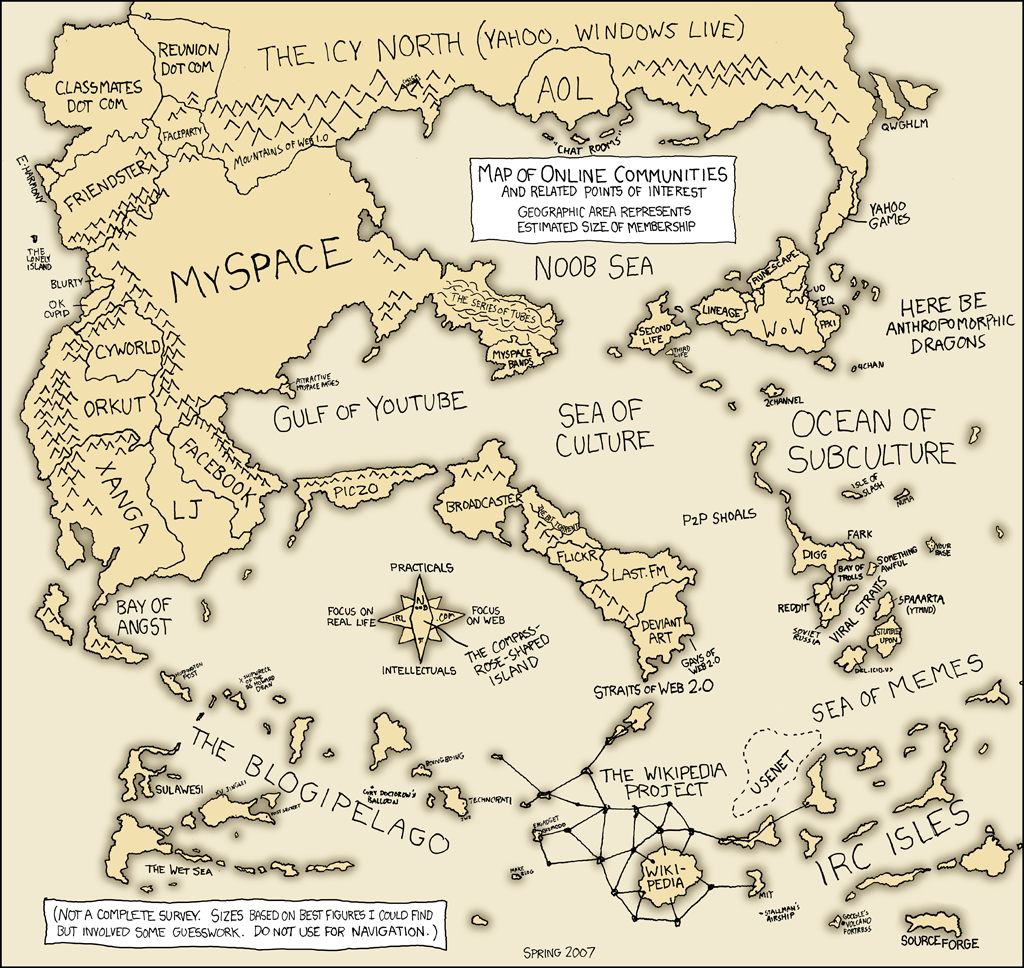
Map of online communities

John Swords, of Electric Sheep, posted a fun and informative map he'd created outlining the various social and virtual worlds as regions. He posted this map as a photo on the Virtual Worlds Conference internal networking site. Since that isn't available to everyone, he kindly offered one that is upon request.

Very funny. My favorite areas are the tiny peninsula dubbed "Attractive MySpace pages" out of the huge MySpace nation, the Viral Straits, the Blogipelago (haha!), and the warning that "HERE BE Anthropomorphic Dragons."

I thought it was interesting how small the kingdom of Facebook, though not small by itself, is in comparsion to MySpace's Empire. John Swords stated that he tried to make the relative size of these "nations" corresponding to numbers of users according to real data. I'd heard that Facebook was kicking butt in this area so I guess the success is not so much overall but relative to the time that it has been in existence.

Monday, September 24, 2007

Virtual divisions: choices shaping technology

I like to think of virtual worlds as a new and future tool for engagement. Not everyone wants to or needs to make use of them. I don't think it's matter of right choice but personal choice. I think predictions that virtual worlds will replace the Web are about as accurate as those who predicted the Web would replace print. There will always be other channels to use, and people will mix and match according to the occasion. And given that the cornerstone of the virtual experience seems to be primarily social - or function in context of social interaction - then I think there will always be channels for those who just don't like the medium - and more power to them as well.

Virtual worlds just don't work for some people. They're too awkward and surreal I suppose, though I think there must be a better word. I share some of people's doubts regarding the current efficacy and benefits of virtual worlds as voiced by some pundits. Sometimes what seems like a good idea doesn't play out in actual use. I've seen some examples where virtual worlds impose a needless application layer over information exchange better served by other methods. The medium of virtual interaction itself can be very distracting sometimes, getting in the way of conducting business.

That said, I'm a big fan of virtual worlds and see a lot of potential. I think situations like I've described above are normal to the process of exploration. People who love a medium are going to bring their processes to it, maybe because they see novel solutions, but I think often more because they just love the medium and want to find - sometimes force - uses that are not an organic fit. Application of existing processes often don't pan out. But some will. And such failures are important because we collectively start to internalize the nuance of the environment and start realizing ways that it differs and works better than what we have already. I think the best uses of virtual worlds have yet to be discovered, possibly because the infrastructure and mechanisms that will allow for them have yet to be developed, but also because that process of initial discovery is still very new and ongoing. Some people will look at these sorts of failures and I think take the wrong message away (or maybe not. It's all conjecture, isn't it and I am a self-admitted advocate after all). <-- grain of salt time :-) So, why do people "love" a medium and adopt it? Sometimes because it suggests itself as being better - but I think that this is rare and mostly not the case, imho. I think it is mostly because, as a form of expression and communication, it better suits the personality of the adopter. They find that they can present themselves better or more fully or with more satisfaction. And since such come to be a more attractive natural form of communication for themselves, they want to use it and get others to use it as well. People forget we're social animals that feel better when part of a group (wanted to say herd). But not everyone will adopt or "get" the new method. Each new channel of communication adds interesting aspects, new forms of information, new capabilities - but all such leave something behind as well. And users who enjoy or are comfortable more with existing channels don't find the new methods particularly attractive. They find they can communicate better and be understood better, get more information across, or just enjoy the nuance more, of existing methods. There's also a cost factor. New methods require new equipment and processes. Not everyone, even those who might be attracted, can find access right away. However, for an established medium, I think that's not the case. Such tend to be ever present, in easy reach. I think we grow up with them and take them as a matter of course and they become natural internal methods - so much so that people who lack those methods are often left to a degree out of touch to those who do "speak" through those channels. So I think from a business perspective the need to understand and find a way to interact in virtual form is generational: what people are seeing in virtual worlds is not necessarily a better form of communication for themselves, but a way to speak to the next generation of workers and consumers through the methods and processes that today's children, teens and young adults use to speak to each other. I know they're out there, but I haven't met a parent yet whose children are not engaged in some form of virtual interaction, be it MTV Worlds, Habbo Hotel, Club Penguin, or MMO games. For current uses, I would say there are three other aspects that are attractive: perceptual, psychological, and practical. The first two relate to areas new to this form of interaction not utilized in say Web or phone communications. The added information provided by immersed dimension I just see as not being able to be duplicated better for now than what's being done in virtual worlds. For educational purposes, spatial relationship is really key to understanding some concepts. Having taken my one class in Second Life so far (I have a dodgy computer that doesn't like it) - I have to say that I found it very engaging. There's something about the manipulation of objects that even though done virtually, it brings something of the tactile experience of working with my hands - something missing in a lot of current education. I think it helped keep me more engaged and focused and I wonder if others wouldn't have the same reaction. I know MIT has done some chemistry courses in SL, requiring the students to assemble molecules and study their relation in the formation of complex elements. Architects have been able to mock up and showcase both practical and fantastic designs to show off or get more immediate feedback - or just to see how they feel walking through the space as framed by their creation. Of course there are CAD programs but they are expensive, have a high learning curve and lack the immediate access to feedback that SL provides - but offer more detailed renderings. Again, different tools for different uses. Psychologically, there's both a vanity and engagment aspect. We make up a little cartoon-like person that is us as far as the world is concerned. I've talked a lot about this elsewhere so don't want to go over too much again. But there's a lot of attraction to the nuance and freedom of expression when we recreate ourselves in these avatar forms. Its not for everyone but even if someone doesn't understand that attraction, don't discount that it is an attractive pull for someone else. And interestingly enough, seeing this three-dimensional form, I think, helps personify that the force we're dealing with is in fact another human being - more so than any chat text, phone voice or e-mail can manage. Short of meeting the real person, and irrespective of whether the avatar is accurate or not, having the same form and movement of a human body, avatars seem to stimulate that response in a lot of people. There was a news report I'd read some time back discussing some interesting initial psychological observations about virtual worlds that said users of MTV Words - where MTV "encourages" the people in the show to come in and interact in avatar form - were really excited and engaged to have "met" and talked to the celebrities. Of course they didn't. They interacted with a cartoon driven by the celebrity. But that association of interaction was similar to having met the real person - at least for some.

Practical to my mind really relates to the ready access of most virtual worlds coupled with their distance negating qualities. True, distance negation is a cornerstone of Web and communication technologies. But coupled with the first two aspects, it really pushes the engagement level up. Distance negating and perceptual environment, distance negating and ego-realization - very different twists on the distance negating aspect that really make it an experience unique to this virtual environment, and not like its Web, phone, or video counterparts.

Bottom line: get it or not, it doesn't matter. People I hope can feel comfortable about "not getting" something and having personal choices that suit them. I can't get The Hills and probably think about that show (and the people in it) the same way some people think about virtual words (and the people in them). My wife loves that show. If she wants to watch it, I can go into the other room and fire up an MMO. I get those. My wife has about the same opinion of them as I do The Hills.